Objective and mission
Overall objective and mission
This project is about the causes and effects of women’s labour market integration, which is an issue that represents a major challenge for the European Union and its member states, and supposedly a precondition for the sustainability of the European social model. The overall aim is to analyse (1) how local welfare systems support women’s labour market participation, as well as (2) the extent to which (and under which conditions) female labour market integration has contributed to strengthening social cohesion. The project focuses on how public and private welfare services such as care and life long learning systems intended to support women’s labour market integration have been designed; on how women of different classes, qualifications, ethnicities, and geographical locations have grasped and made use of such policies, and on how the increase in women’s labour market integration has affected structures of inequality and social cohesion. Hypothesis and analytical relationships are outlined together with the central concepts of the project in Figure 1.
|
|---|
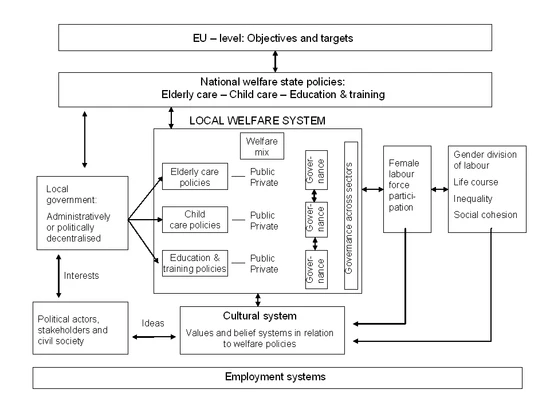
When EU leaders met in March 2000 the Lisbon European Council considered that the overall target was to raise the employment rate for women to more than 60 % by 2010. The Lisbon Agenda was based on a partnership between the Commission and the Member States. The delivery of welfare services that are expected to foster labour force growth, however, is the prime responsibility of local governments, and local governments do not always respond adequately to the political signals of the EU and/or national government. Local governments have some autonomy with regard to policy formation as well as the design and implementation of policies. The degree of autonomy somewhat depends on the degree of decentralisation, and two major forms of decentralisation can be observed (cf. Mosley 2003). Administrative decentralisation refers to the delegation of operative responsibilities and implementation of national policy objectives to bureaucratic managers in regional or local offices, while political decentralisation refers to the delegation of responsibilities to relatively independent local political entities with their own resources and elected leadership. Whatever the case, localities and cities are in part clearly different from their countries and huge local differences exist with regard to the provision of welfare services (European Commission 2005). Within countries there are large differences between regions and cities regarding the ways in which women’s labour market integration is supported, for example, by the provision of care services (European Commission, 2009) as well as how human capital investments and lifelong learning is orchestrated (Morel et al 2009). It will therefore be considered how goals and targets set by the EU have been transformed into national policies and implemented locally, epitomised as vertical cooperation/integration.
Policies that support the integration of women into the labour market delineate the rights and obligations of citizens. Hence, the extent and design of policies, including access to services, quality of services and conditions of labour in such services, will be considered. Public policies furthermore help to structure the relationship between public, private and third sector providers of welfare. For instance, affordable high quality public care institutions reduce the necessity of informal, voluntary or for-profit initiatives. As such, public policies structure the local welfare-mix. The welfare-mix refers to the division of labour between the public sector, for-profit and non-profit providers of welfare services as well as the family or the company (Evers & Olk 1995). How a welfare-mix is constituted by different providers and partners will be considered.
A wide range of policies are conducive for the integration of women into the labour market. In this project, however, we have singled out three different types of welfare policies (and services) which we consider to be of major importance for the integration of women into paid employment; i.e. elderly care policies, child care policies, and life long learning and vocational training policies.
These policies represent a social investment and life cycle approach helping women to enter, reenter or remain in the labour market throughout the life course. Of course, a relationship exists between the three types of policy. For instance, child care institutions will not help women to enter the labour market if they suffer from inadequate skills or are burdened by taking care of frail elderly relatives. Thus, horizontal cooperation and ‘governance’ networks – within and across the different tiers or sectors of welfare – are needed for policies to be effective. Governance in this sense refers to “the process through which public and private actors and resources are coordinated and given a common direction and meaning” (Peters & Pierre 2004:78).
It is widely agreed that no single causal factor such as the availability of childcare facilities can explain the inclination of women to enter the labour market (e.g. OECD 2004). First, all day care institutions have not solely been constructed for labour market purposes (e.g. Moss 1996), i.e. opening hours may not correspond to a normal work week. Institutions are also constructed with the aim of improving the socialisation of children, and in come countries the socialisation motive predominate vis-à-vis the employment perspective. Second, during their life-cycle women draw on and make use of a multiplicity of policies facilitating their labour market career. In sum, they draw on the welfare system as a whole. The welfare system refers to the whole configuration of public and private policies intended to support (or counteract) female employment, for instance (elderly and child) care and life long learning and vocational training policies; the welfare system furthermore refers to the variety of providers and partners involved in the provision of welfare services (the welfare-mix) and how they are governed (sector specific and cross-sectoral governance networks). The welfare system is an opportunity structure, and it functions as the basis for female decision making (to enter/remain or not to enter/remain on the labour market) at different stages of life.
A welfare system is not arbitrarily given. Rather, a given welfare system is based on cultural values and ideals (“Leitbildern”). In this project culture is defined as a “system of collective constructions of meaning by which human beings define reality” (Neidhard et al 1986:11). It includes values and belief systems to which the relevant social actors, the institutions of the welfare state and concrete policy measures refer (Pfau-Effinger 2005a), and these different dimensions vary on an international and local scale. Local welfare systems are thus embedded in local contexts of welfare cultures, which mark the extent to which state intervention in the market is most adequate; how social services should be provided, and the extent to which the state or private providers are regarded as the “natural” supplier of welfare; ideas about the gender division within and out-side the family, and justice in relation to redistribution and so on.
Cultural values and belief systems furthermore condition creativity among political actors and stakeholders. Welfare cultures thus restrict the spectrum of possible welfare policies in the sense that societal ideas limit the range of options considered by political actors and shape the range of options for individual choice (see also Lepsius 1990). Cultural ideas, however, do not have a determining influence on politics. Cultural ideas are not hegemonic. Inside a given culture divergent or even contradictory values and ideals may exist. Accordingly, Kluegel (1989) has made a distinction between dominant value orientation and challenging beliefs. Thus, political actors and stakeholders like companies, political parties, trade unions, employers’ organisations, NGOs etc. may have different interests and welfare policies of local government are the result of conflicts, negotiating processes and compromises of political actors in relation to their ideas and interests, and political decision making at the local level may actually be counter-productive vis-à-vis EU ambitions and targets.
The right side of the conceptual model indicates that local welfare systems transform into formal (and informal) social practices epitomised as the degree to which women are integrated into the labour market. Welfare systems, however, do not determine practices in a deterministic way.
Rather, policies function as conditions for social action, i.e. policies are conditions for the decision making of women as to how they combine various forms of formal and informal work in different spheres of society and at different stages of life (Giddens 1984; Bourdieu 1977; Pfau-Effinger 2005b). The conceptual framework thus leaves room for individual deviations in the way women combine education, employment and care responsibilities depending on the overall context and individual dispositions. For instance, low skilled and low paid mothers in anti-social and unfulfilling jobs may find it more important – and more fulfilling – to be with the child as compared with highly educated and well paid women.
The way in which women combine education, employment and care responsibilities is relevant for the gender division of labour; for the life course of women (and men) and for inequality. Inequality, however, is a highly contested concept, as it is possible to make a distinction between absolute equality, equality at the start, equal treatment, equal rights, and equal chances (Lautmann 1990:28ff). In a gender perspective absolute equality refers to a situation where men and women are entitled to the equal shares in social resources. Equality at the start means that the initial conditions for acquiring social resources and reaching social positions are the same for men and women. Equal treatment has to do with the removal of all sorts of discrimination, while equal chances refers to the idea that everybody should have the same opportunities for getting rewards and achieving attractive positions. It can be assumed that the principles of equality that play a role in the discussion about modernization of gender relations vary from country to country, and from one locality to another.
Furthermore, the integration of women into (well) paid employment will almost inevitably affect social cohesion. At a generalised level the Council of Europe has defined social cohesion as “the capacity of a society to ensure the welfare of all its members, minimising disparities and avoiding polarisation” (Council of Europe 2004). The concept of social cohesion is thus understood as an objective, a process and an acquisition (Council of Europe 2005:19). As an objective, cohesion refers to four aspects of well-being for all, which include (1) equity in the exercise of rights, (2) dignity and recognition, (3) autonomy and personal fulfilment, and (4) participation and commitment. As a process, cohesion refers to the political action (see the left side of Figure 1) required for social cohesion, and as acquisition cohesion refers – among other things – to labour force participation. That is, within the EU discourse employment is supposed to lead to social cohesion. Accordingly, central Eurostat indicators for social cohesion are “at risk of poverty” rates, and – importantly – the “dispersion of regional employment rates by gender”, and so on (see also Perrons 1998). In this project it will be considered how and under which conditions an increase in women’s labour market integration actually affects social cohesion.
Social practices such as the degree and forms of women’s labour market integration, social structures such as the gender division of labour, the life course, inequality, as well as social cohesion are out-comes of the welfare system, and the culture in which the welfare system is embedded. Out-comes thus reflect the dominant value orientation and belief systems towards the structures of social inequality and of the division of labour in society, and such out-comes tend to function as a feed-back mechanism on the cultural system and the support for existing welfare policies (Larsen 2008). It can therefore be expected that a modernisation of gender relations will usually be path-dependent, since basic elements of the institutional and cultural context are partially maintained in the face of ambitions to change the social world. Moreover, it can be assumed that the ways in which the welfare culture and the welfare system interact, and the degree to which their relationship is characterised by complementarity or incomplementarity, has an impact on the degree of social cohesion (Pfau-Effinger et al. 2009) – and vice versa.
Local economies and production systems are, of course, a crucial dimension of economic and social development. Important factors are the economic structure of the region, i.e. whether the regional economy is based on industry, service, agriculture, tourism etc.; the role of informal employment; integration of immigrants, degree of self-employment etc. Economic growth and prosperity however, are not solely dependent on such ‘objective’ factors. As shown in the literature about ‘industrial district’ (e.g. Piore & Sabel 1984; Becattini et al 2003) and ‘production regime’ (e.g. Hult and Svallfors 2002; Gallie 2007) economic growth may equally be dependent on cultural factors such as values, commitments, attitudes, social trust and the ability of employers to cooperate, which may in turn encourage technological development and knowledge diffusion within the local area.

